

NEW YORK — Any time you give up a goal on your own power play before even registering a shot on net, you know it’s going to be a bad night.
And this was a bad night for the Montreal Canadiens.
It was arguably their worst one since they started their season with a fortunate 3-2 win in Toronto on Sept. 29.
That victory over the Maple Leafs was one of two nights in which the Canadiens had all their power-play regulars available to them, which is undeniably part of the reason why their power play has been dysfunctional for the last 19 games.
But even without Ivan Demidov—a dynamic, triple-threat player who can shoot, pass and deke opponents to open up all kinds of options—it shouldn’t be this bad.
“Demi’s a special player and a threat when he has it, when he’s shooting it,” said Nick Suzuki. “Obviously we miss him, but I feel like we have the talent and the players to make up for that.”
Suzuki is one of them, though his six-game absence didn’t help the power play.
Cole Caufield, who’s coming off a 51-goal season, has been there all along, and he’s an elite power-play option. As is Juraj Slafkovsky, who scored 15 of his career-high 30 goals last season on the man advantage.
And if Lane Hutson isn’t the best power-play quarterback in the league, he isn’t far off.
But even with all of them in place and sniper Zachary Bolduc in Demidov’s spot, the Canadiens’ top unit hasn’t clicked. And it takes up too much time for the second unit to pick up the slack.
Still, to see the sum of it add up to so little is shocking.
The power play came to New York in an 0-for-10 stretch, and yet Suzuki said a 30-minute video session with coach Martin St. Louis revealed it was, in his words, “definitely not broken.”
That was a conclusion based on goals being left on the table—back-door tap-ins unfinished—and if it was an accurate one, it didn’t hold through Monday night at Madison Square Garden.
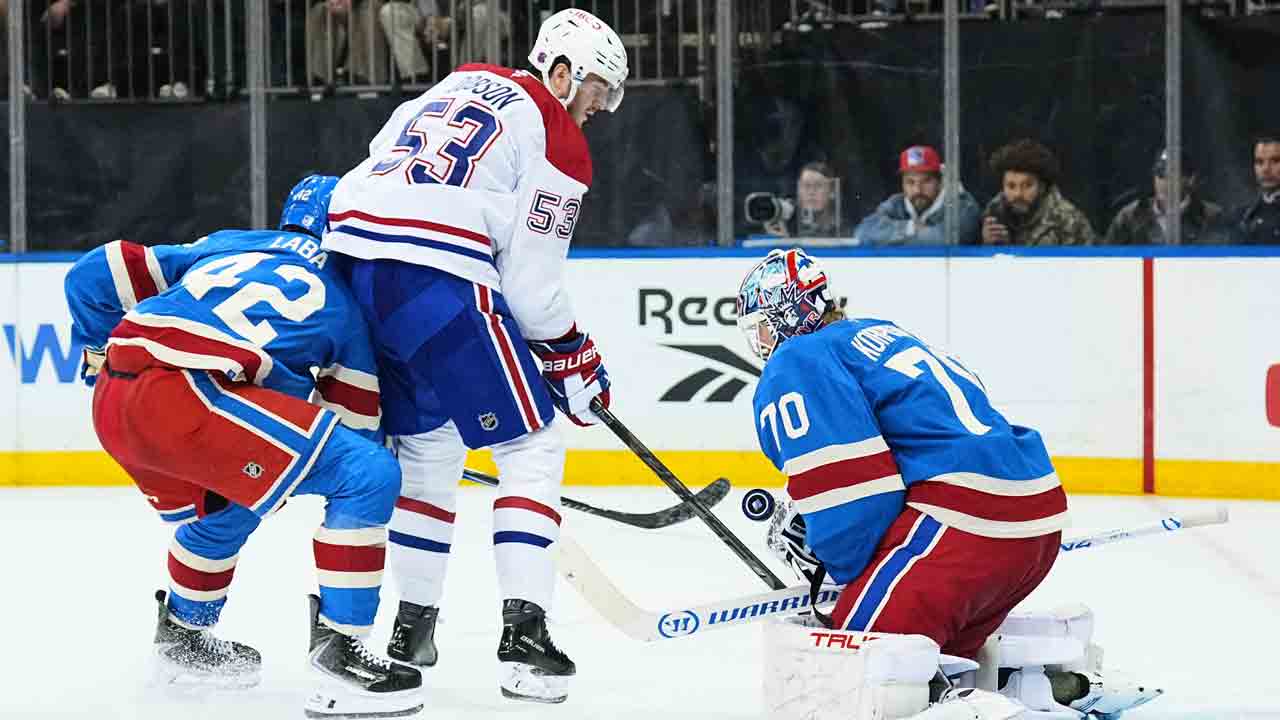
The Canadiens came in on the 100th anniversary of the Rangers' first NHL game and shattered their already-fragile power play, passing up four opportunities to shoot, giving up a short-handed goal, and then surrendering all momentum they hoped to generate en route to a 3-1 loss.
“We controlled the game in the first,” said St. Louis, “but that’s about it.”
When asked what happened after that, he chuckled and responded, “Nothing.”
“It's not funny, but that's it,” St. Louis said. “We were flat, no energy, unable to execute.
It was pretty much the worst hockey we’ve played all year, and I know that’s going to happen. We weren’t there.”
He has always said that his best players’ confidence at five-on-five is built on the man advantage, and he can surely see how it’s being deconstructed when that aspect of play fails.
Hence Montreal’s most threatening offensive players against the Rangers were Phillip Danault (a mostly defensive centre who scored their only goal) and Arber Xhekaj (who rarely gets as much opportunity to showcase strong offensive skills as the team’s fifth defenceman). Neither of them are on the power play.
Danault got a chance late in the game when the Canadiens were awarded a power play with 4:17 remaining.
But he and they fumbled at five-on-four before finally generating a couple of threats at six-on-four.
The Canadiens had a brief six-on-three after Will Cuylle, who scored twice for the Rangers, high-sticked Suzuki.
But they flubbed it before blanking at six-on-four through most of the final two minutes.
“It’s a department that needs a lot of focus,” said St. Louis, and he was talking about the power play in general, and not late-game two-man advantages.
“We missed the net a lot, had shots blocked,” St. Louis added. “Execution wasn’t there.”
32 Thoughts: The Podcast
Hockey fans already know the name, but this is not the blog. From Sportsnet, 32 Thoughts: The Podcast with NHL Insider Elliotte Friedman and Kyle Bukauskas is a weekly deep dive into the biggest news and interviews from the hockey world.
Latest episode
There’s an undeniable mental element to it, especially after four straight games without a power-play goal.
“I think the more games you go without producing on the PP, I think the pressure rises for sure, probably the stress level goes up,” St. Louis said. “You’re chasing the clock, you’re chasing the game.
It’s uncomfortable right now for those guys on the PP, and we’ve got to find a way to get them comfortable through conversations, through some teaching, through some reps. But you know, we had a really good power play last year.
I know we’re going to sort that out.”
The sooner the better, because 8-for-60 was a terrible conversion rate before Monday’s game but somehow not a particularly costly one.
Blanking on four chances in Monday’s game proved very costly—and not just on the scoreboard.
“I think it can affect us mentally,” said Suzuki. “When we’re used to doing well on the power play, it can bleed into your five-on-five play.
I think me and my line have to be a lot better if we’re going to win games.”
Almost everyone on the Canadiens must be a lot better than they were in New York, but the power play can have a way of bailing you out of games in which most of your players are flat or off.
In this game, it was the main thing that deflated the Canadiens.
“I hope it’s just a one-off,” said St. Louis, knowing it won’t be if it continues to operate as it has so far.
MORE FROM SPORTSNET
Canadiens quarter-mark report card: Montreal living up to expectations