

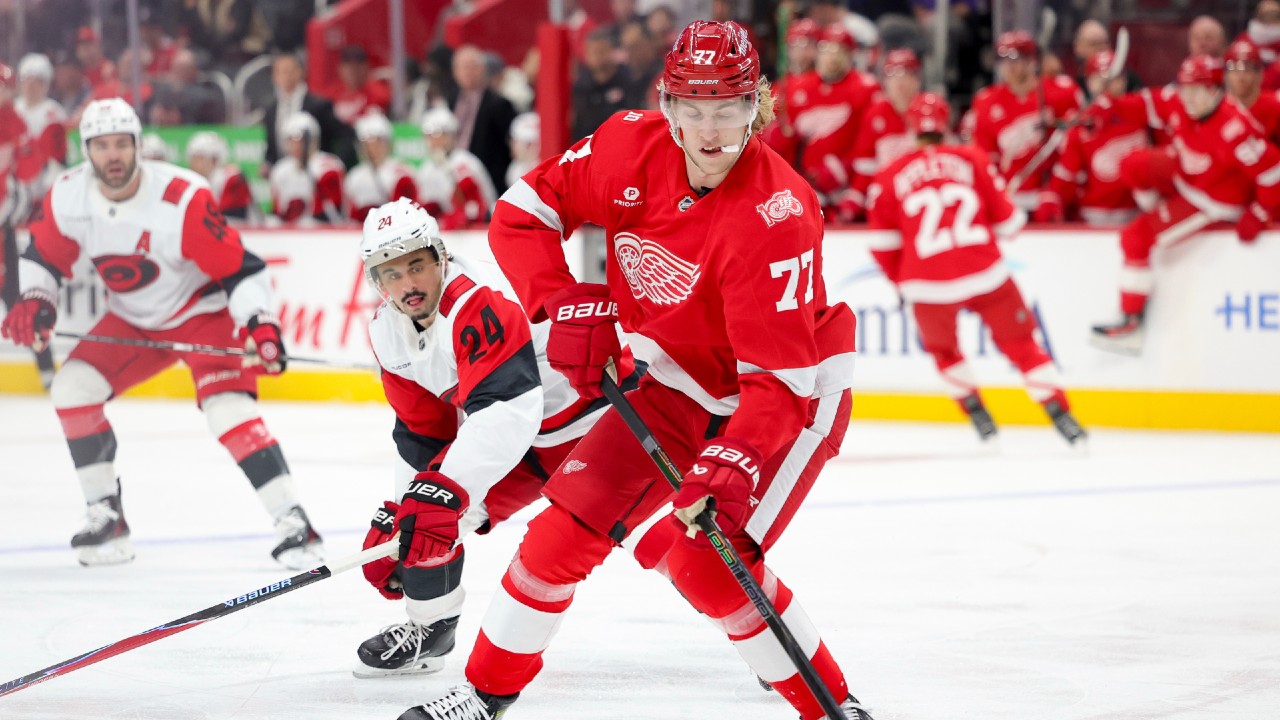
Time is up on Simon Edvinsson’s tenure with the Detroit Red Wings — the only question that remains is whether a trade will be executed prior to Dec. 1’s deadline or cost him the season.
While interim GM Shawn Horcoff indicated as recently as last week that his intention was still to sign Edvinsson, that ship has sailed.
Sources say multiple teams made overtures on offer sheets in an attempt end the saga but Edvinsson has chosen not to engage because he does not want to give Detroit an opportunity to match.
“He’d love to be signed and playing,” one source said. “But he no longer wants to play in Detroit and that would be the risk with an offer sheet.”
Ten of the 14 offer sheets signed in the NHL’s salary cap era have been matched by the team holding the restricted free agent, including both Leo Carlsson and Barrett Hayton last summer.
The clock is ticking. Horcoff and the Red Wings seem comfortable making the Edvinsson camp sweat by taking it to the deadline, now just 12 days away.
Deadlines produce transactions in the NHL but there is considerable risk on both sides in this game of chicken.
For Edvinsson, his age-23 season hangs in the balance. A contract for Edvinsson must be registered with the NHL by 5 p.m.
ET on Dec. 1 for him to be eligible to play with any team for the remainder of the season.
For the Red Wings, it’s entirely possible that the trade return weakens leading up to Dec. 1 as opposed to getting stronger.
Opposing teams believe inaction is not an option, that they won’t want to kick the can down the road until next summer. No team is going to trade prime assets for a player ineligible to play this season.
Waiting until the last minute might not leave enough time for negotiation to get a deal signed. And beyond that, each passing day materially changes the next contract for the team acquiring Edvinsson.
Remember, there is a daily cap penalty during the first year of the contract for any RFA signed after the start of the regular season.
If Edvinsson is on track to sign a seven-year deal worth $10 million per year with a flat base salary, to use round numbers, the first year cap hit of that deal would be $13.21 million if registered today. That cap hit will increase by roughly $76,000 per day — so the same contract executed on Dec.
1 would come with a first-year cap hit of $14.22 million. Not many teams could add a $14.2 million cap hit to their roster right now without surgery.
Edvinsson deadline workaround?
No team or player has done it yet, but is there a potential workaround to the Dec. 1 deadline for Edvinsson?
If the witching hour arrives, the Red Wings and Edvinsson could theoretically agree on a one-year deal to be registered before the deadline to save his season. It would require trust, of course, but sign Edvinsson to a one-year deal and then subsequently suspend him (without pay) until a trade can be executed.
It would be in the player’s interest to keep the viability of his season alive. It would be in the team’s interest because it would keep trade talks alive.
And it wouldn’t cost Detroit any real money if he remained suspended.
Right now, the mutually assured destruction (MAD) theory applies to the deadline for both sides — and it’s in no one’s interest to move off that for the time being. The simple solution is to get a trade done.
But there is potentially an alternative path.
How are assists audited in NHL?
With so much intrigue surrounding Connor McDavid’s chase for a 200-point season and angst around how assists are doled out, Sportsnet reached out to the NHL’s Hockey Operations department for clarity on the process.
Here’s how it works:
1. Official scorer in the arena uses Hawkeye replay system in the press box to review additional angles with the ability to rewind and slow-mo replay to properly designate goal scorer and assists for any scoring player.
They are then inputted in Hockey Information Tracking System (HITS) software, which relays information to NHL.com and scoresheets.
2. If the official scorer has a question or is unsure about whether an assist should be credited, the scoring sequence is flagged for ultimate determination by the NHL’s situation room in Toronto, where a staff member reviews or audits any scoring sequence in doubt.
3. The NHL’s situation room and official scorers apply the same standard consistently across all 32 venues, relating to Rule 33.2: “An assist is awarded to the player or players (maximum two) who touches the puck prior to the goal scorer, provided no defender plays or possesses the puck in between.” While there can be debate at times as to who propels a puck forward, it’s cut and dry and the same standard that has existed for 100-plus years, the only way to keep scoring consistent across all eras.
4. Nearly any scoring sequence with a question is audited by the Situation Room in real time or near real time, within 10 or 20 minutes of the play.
By and large, nearly any game’s scoresheet is settled before teams exit the arena. This is also true for any other statistics kept, including shots on goal, blocked shots, hits, etc.
5. When in doubt, an assist is not added to a scoring play because the NHL does not want to be in a position to rescind points from players.
They would rather have the ability to add later.
6. If a team wishes to appeal, they can petition the hockey operations department that night or the following day.
However, the vast majority of appeals by teams are denied because, by that point, the scoring play has passed through multiple layers of eyes who are making the same call on thousands of goals all season long.
MORE FROM SPORTSNET
NHL power rankings: Checking in on all 32 coaches
Handing out alternative NHL awards for the first quarter