

My process of assembling the leading Calder Trophy candidates through the first quarter of the year has revealed some interesting trends from this year’s NHL rookie group.
It’s easy to get caught up in a player’s point totals, or a goaltender’s goals-against average. But what else has been standing out about the current trajectory of these players?
Is their ice time on the rise? Is their defensive detail improving?
Are they showing a willingness to do the little things like block shots?
Last June’s top two picks, Gavin McKenna and Ivar Stenberg, entered the season as two of my favourites to win the Calder, but 25 per cent of the way through, I'm seeing other, stronger candidates who I'll focus on in this piece. However, over the course of an 84-game schedule every team and player evolves in one way or the other so it’s important for me to dissect segments of games before arriving at some sort of conclusion regarding positive and negative trends.
Things will inevitably change several times throughout the year, so McKenna and Stenberg still might land among the favourites by the end.
Here’s a look at my top five Calder Trophy candidates so far this season:
No. 1: Jacob Fowler, G, Montreal Canadiens
Fowler has taken over as the starting goaltender in Montreal and he’s giving me Carey Price vibes, which I recognize is a lofty comparison. But I honestly feel as though Fowler is tracking to be an upper-tier, No. 1 NHL goalie.
Through his first 14 starts Fowler’s stats speak for themselves. He’s 10-2-2 and posted the fifth best goals-against average (2.19) and fourth best save percentage (.924) in the league.
Referencing some of the underlying trends I’ve been attempting to unearth with my process, here’s a look at Fowler’s save percentage map:
Every netminder in the NHL is capable of making routine stops from long-range. What NHL teams really need from their goalies is to come up with timely, high danger saves.
Looking at Fowler’s save percentage map below shows the quality of his play in comparison to the rest of the members of the NHL goalie union.
If Fowler ends up playing the majority of Montreal's games the rest of the season he will remain part of the Calder Trophy conversation, and possibly the Vezina Trophy discussion, too.
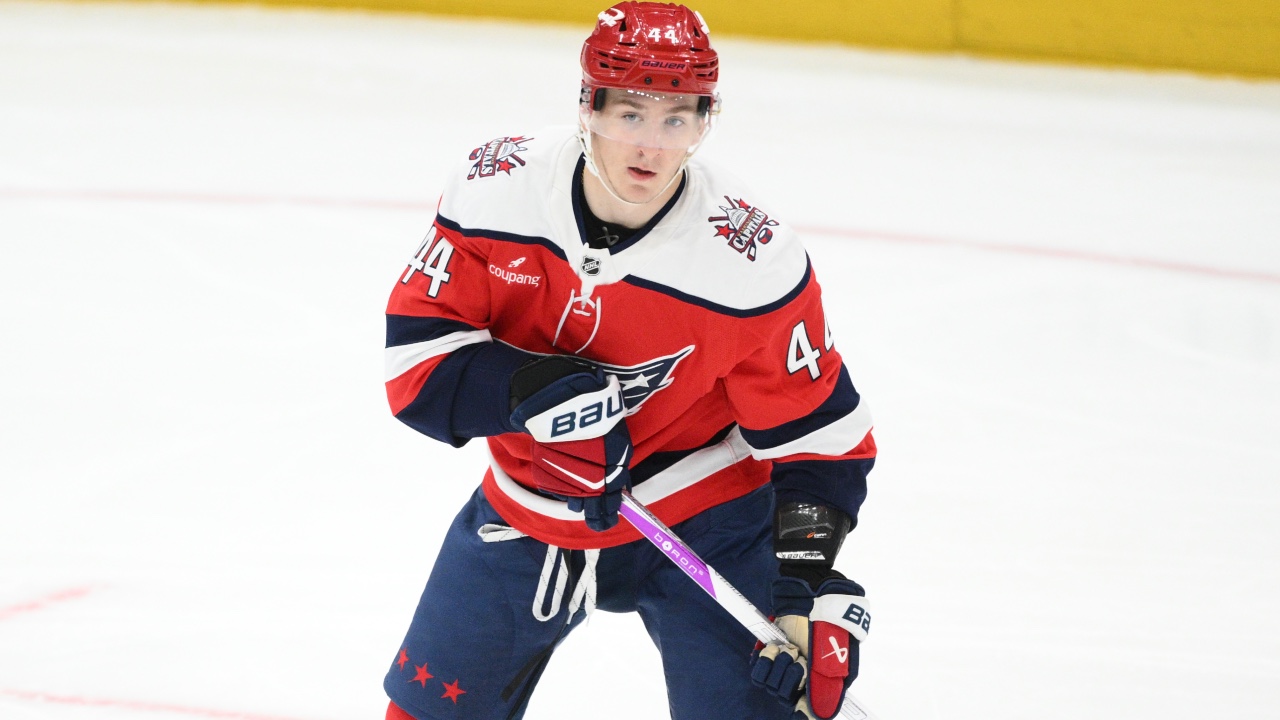
No. 2: Cole Hutson, D, Washington Capitals
Members of our Sportsnet team who had the privilege of sitting down with Hutson before the 2024 NHL Draft will fondly recall the impression he made on them. Cole wanted nothing to do with comparisons to his older brother Lane.
I found the conversation fascinating, especially considering the obvious similarities with their overall approach.
On balance, the Washington Capitals haven’t completely hit their stride as a team this season, but Hutson has been fantastic. He’s currently the second-leading scorer for the Caps (5G-10A) and is averaging just under 20 minutes of ice time per game.
All his shifts come at even strength and on the power play. He’s an elusive playmaker, but Hutson has also been one of the most aggressive defencemen in the league directing pucks on net.
Another area of Hutson’s game that has my attention is his willingness to physically engage his opponents. He’s never going to be thought of as a punishing player, but I’m excited about the fact he has dolled out nine more hits than Jakob Chychrun and 10 more than Timothy Liljegren.
Hutson's willingness to engage defensively has led to a very strong plus-3 rating so far this season.
No. 3: Michael Brandsegg-Nygard, RW, Detroit Red Wings
Most of the news coming out of Detroit this season has circled around Dylan Larkin’s trade request and the Red Wings' inability to get young defenceman Simon Edvinsson signed to an extension. But some good news out of “Hockey Town” has been the play of Brandsegg-Nygard.
Brandsegg-Nygard is contributing in a variety of ways for the Wings. He’s averaging over 15 minutes per game of ice time and all his shifts have come at even strength and on the power play.
His contribution offensively doesn’t jump off the page (4G-7A in 22 games) but his complete game has my full attention. Brandsegg-Nygard has registered a plus-10 rating, he competes up and down the ice surface and plays a detailed game on and off the puck.
An area of his game that stands out amongst his peer group of rookies is his physicality. Brandsegg-Nygard has been credited with 102 hits, which is 47 more than the next-closest Red Wing (Keegan Kolesar) and good for fifth overall in the entire NHL.
No. 4: James Hagens, C/W, Boston Bruins
Hagens is currently on the shelf nursing what looked like at the time like a back injury as a result of a cross-check from Pittsburgh Penguins defenceman Samuel Girard. He’s been out of the Bruins lineup for almost two weeks, and his absence has been noticeable.
Through his first 17 games Hagens had contributed 6G-6A and he is another rookie who's been deployed on the power play. Before suffering his injury Hagens was proving to be an efficient playmaker and shooter in the offensive zone.
His elite element has always been what he can provide offensively and we can see this at the NHL level through his shot distribution, and volume, when looking at where on the ice he's directing pucks on net.
A shot map like this displays how difficult Hagens can be to defend as well as how good his rink-wide vision is. When he’s in motion, he scans the entire playing surface looking for scoring chances.
It’s noteworthy that 23 of his shots on net have come from between the circles in the middle of the ice and around the crease.
An area of Hagens' game that improved immensely over the years is his defensive effort. Hagens is a plus-7 so far this year and his 19 shot blocks are tied with Mark Kastelic for the team lead amongst the forwards.
No. 5: Trevor Connelly, LW, Vegas Golden Knights
Connelly is off to a solid start and, despite a recent four-game mini-slump during which he was held off the scoresheet, he responded by recording two assists versus the Dallas Stars and a near-season-high 16:48 of ice time. The Golden Knights are an interesting team in that they have skaters who play the game with mid-range pace (Mark Stone) and others who are calculating with their change of speed (Jack Eichel).
Connelly adds a speed and skill element that stands out on its own.
Connelly currently sits tied for second in rookie scoring with 7G-7A. He uses his speed to create time and space and has been aggressive directing pucks on net.
His 49 shots on goal lands in the top 12 per cent of the league. Connelly isn’t killing penalties, but his plus-2 rating provides me enough confidence in his defensive game.
He generally plays with enough detail defensively, which provides him the freedom to push the narrative offensively.
MORE FROM SPORTSNET
One question facing each NHL team at the season quarter mark
Top storylines to watch for in second quarter of NHL season